

Rafael Dussan
Drawing, body and nature
Rafael Dussan is a Colombian artist with over thirty years of practice. With a background in philosophy, theology and psychology, he trained in visual arts in Bogotá, Paris and Milan. Drawing is central to his exploration of the body, nature and the human condition, including the colonial history of Colombia and Latin America. His ties to Cartagena de Indias extend to its artistic and literary circles, where he formed friendships with figures such as Alejandro Obregón and Gabriel García Márquez.
He has exhibited at the Museum of Modern Art of Cartagena, the Museo Santa Clara in Bogotá, the Museo dei Bozzetti in Italy and ACC Galerie in Weimar. His work is held in the collections of the Museum of Modern Art and the Historical Museum of Cartagena, as well as private collections across the Americas and Europe.
Selected solo exhibitions
Naturaleza heroica
Museum of Modern Art of Cartagena, Colombia · 2025
Trazos de Antología. Obras 2001–2024
Galería del Club El Nogal, Bogotá, Colombia · 2025
Altera Pontis
Historical Museum of Cartagena, Colombia · 2018–2019
Presencias
Museo Santa Clara, Bogotá, Colombia · 2013
Museo dei Bozzetti
Pietrasanta, Italy · 2007
Polymorph Pervers — Die Nachtseiten der Liebe
ACC Galerie, Weimar, Germany · 2005 · Group exhibition
Full biography and exhibition history available on request.
ARTWORKS
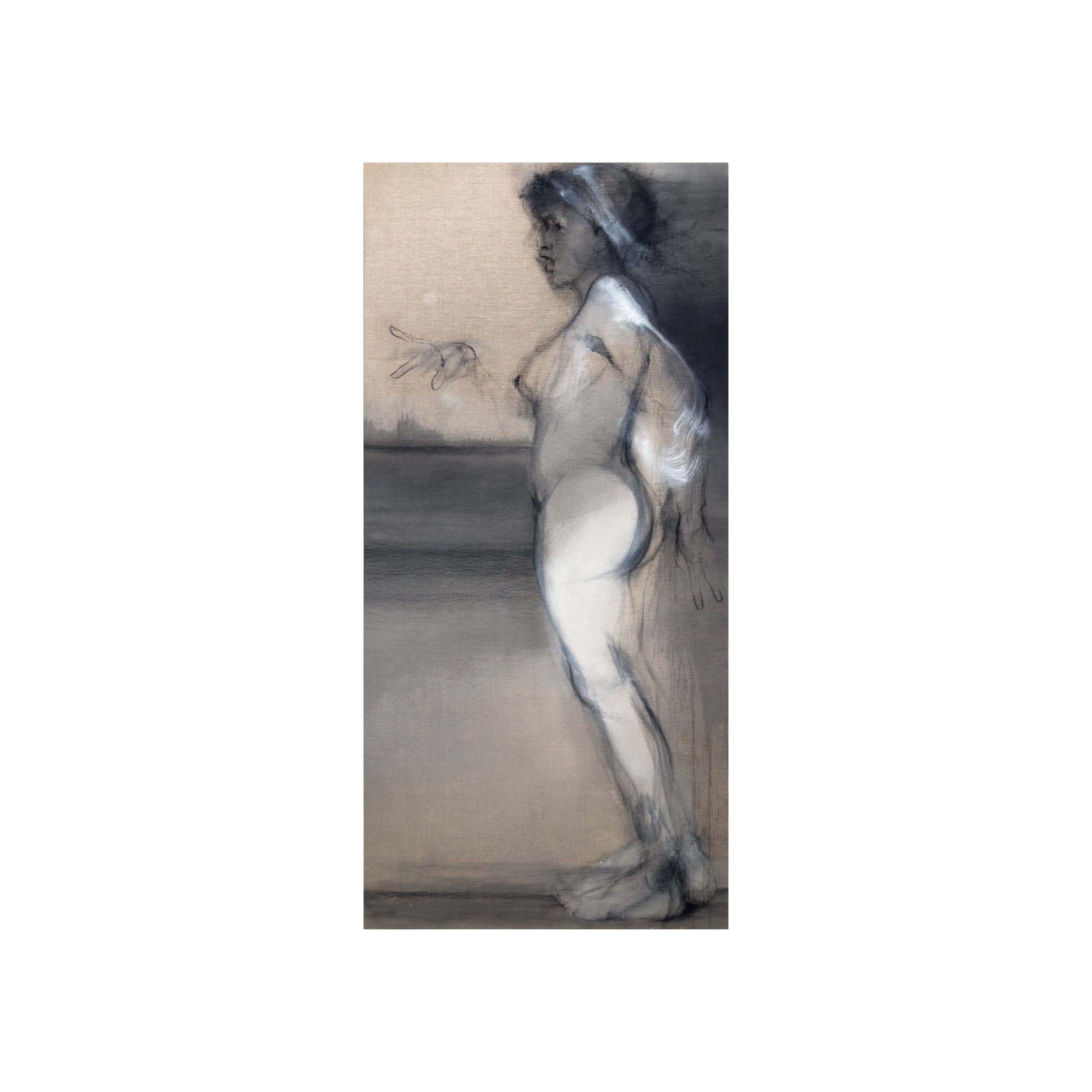
Guiomar Bras (2009) is an original painting by Colombian artist Rafael Dussan, made with acrylic and charcoal on canvas, measuring 99 × 208 cm, and available through Matiz Gallery in Barcelona. Dussan’s practice centres on drawing and the human body, exploring sensuality, vulnerability and the histories that shape human experience.
The painting depicts a nude Black woman whose body seems to move mysteriously through the charcoal drawing. Dussan’s handling of the figure gives her an elusive, sensual presence, evoking the intertwined worlds of history, spirituality and everyday life associated with Latin American magical realism. The body becomes a place of freedom and desire, raising the question of sovereignty: the right to govern oneself.
The accompanying artwork notes identify Guiomar Bras as a woman enslaved in the gold mines of seventeenth-century Antioquia, in present-day Colombia, and prosecuted by the Inquisition in Cartagena de Indias. This Catholic tribunal enforced religious orthodoxy within the Spanish colonial order. Dussan dedicates the work to women mistreated and accused of witchcraft and artes del bien querer—practices associated with love and desire. His tribute places their freedom, sensuality and vital force against the authority that sought to control their bodies and lives.
Spiritual gatherings could also become spaces for solidarity and resistance among enslaved people. In the Caribbean, the relationship between Vodou, an Afro-Haitian religion, and the Haitian Revolution offers an example of religious practice supporting a struggle for collective liberation. This wider history gives the painting’s mysterious atmosphere a political resonance: a space for preserving knowledge, imagining freedom and asserting ways of life beyond colonial control. Within this reading, magical realism brings spiritual life into conversation with struggles over land, memory and sovereignty.
The painting is presented in Cuerpo y territorio (Body and Territory), the third exhibition in BASPcr, Matiz Gallery’s programme connecting art, intercultural exchange and research into the neighbourhood where the gallery operates. The exhibition explores the body as a means of expression and territory as the material and political conditions in which we live.
In Barcelona’s Sant Pere, Santa Caterina i la Ribera neighbourhood, these questions invite attention to how immigrant communities express themselves through movement, dance, dress and everyday presence. Bodies carry memories and cultural practices between places, contributing to the life of the city. Guiomar’s figure brings bodily autonomy into this conversation: the freedom to inhabit, express and make decisions about one’s own body.
Understanding territory also means learning how the place we inhabit is governed, who controls its resources and where collective action is possible. Guiomar’s story directs attention to the mine and the colonial institutions that shaped her circumstances. BASPcr brings that attention to where we live and work today. Through art and territorial research, the programme seeks to make these relationships understandable, strengthening our capacity to organise, resist and transform our material conditions.
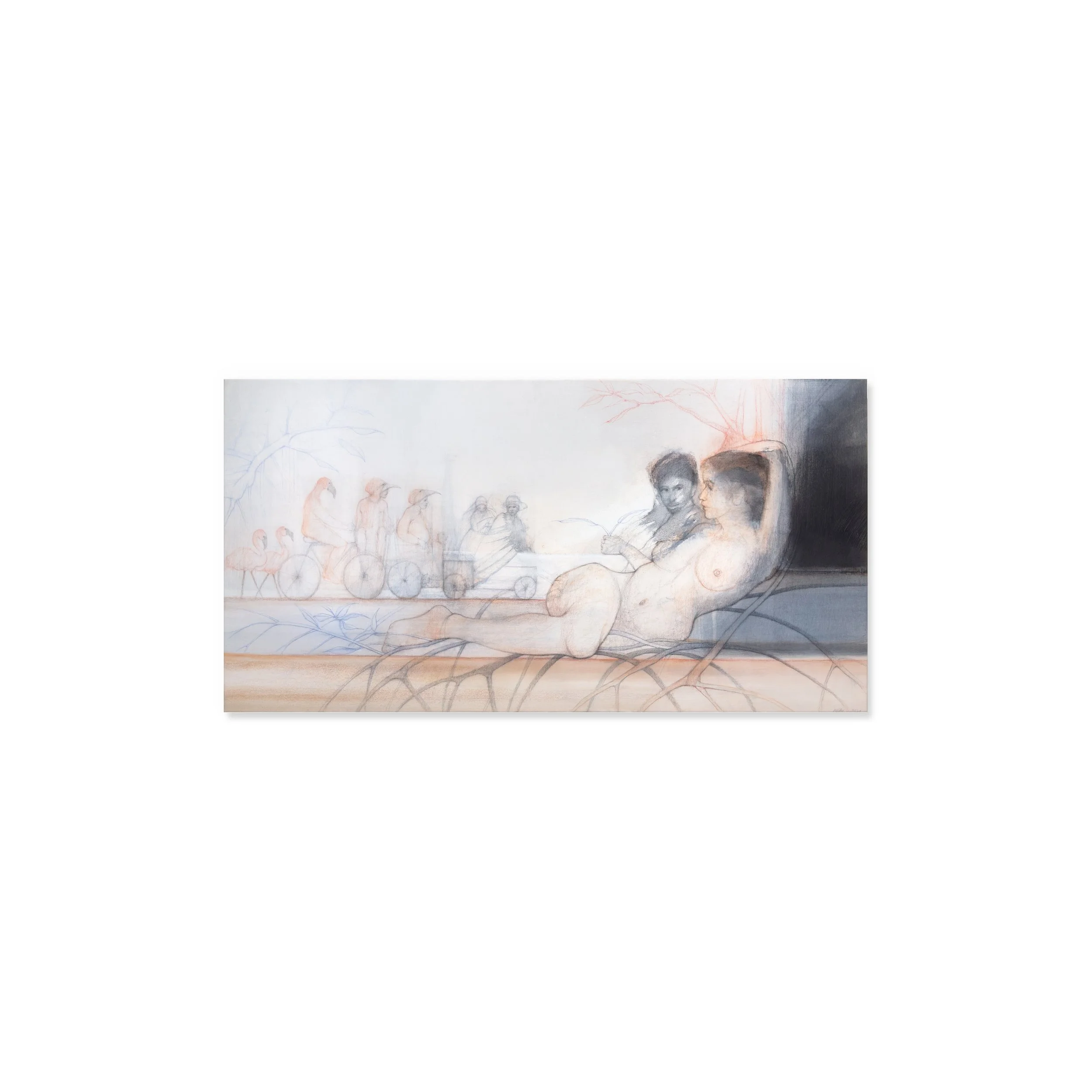
Afrodita Caribe — La danza (2023) is an original painting by Colombian artist Rafael Dussan, measuring 125 × 65 cm, available through Matiz Gallery in Barcelona. Dussan’s practice centres on drawing and the expressive possibilities of the human body. Here, a reclining Afro-descendant woman rests above mangrove roots, surrounded by birds, smaller figures and a scene of movement. Fine outlines and translucent colours give the composition a delicate, poetic character, with darker shading concentrated around the figures on the right.
The woman’s reclining posture gives the painting an openly sensual quality. Around her, flamingos and figures with birdlike features introduce a playful, enigmatic atmosphere. The scene brings recognisable elements of Caribbean life into an imaginative arrangement, allowing everyday experience and the extraordinary to coexist. This is the context of magical realism through which the exhibition approaches the work, leaving its individual symbols open.
Mangroves and flamingos belong to the actual landscapes of the Caribbean. Around Cartagena, the Ciénaga de la Virgen and La Boquilla offer a geographical reference for this encounter: mangrove waterways support diverse wildlife, and flamingos have been documented in the lagoon. These places help ground the painting’s imagery without identifying it as a depiction of one particular location.
The reclining body also opens a conversation about shade and rest. In a hot climate, shade creates the conditions for pausing, gathering and spending time together. Architecture gives these needs spatial form through courtyards, covered galleries and the zaguán, a sheltered entrance passage connecting the street with the interior of a house. Cartagena’s courtyard architecture demonstrates how buildings can respond to heat through the organisation of shelter, air and outdoor space.
Within the exhibition, this relationship between the body and its surroundings brings rest into the discussion of freedom: having time for oneself, enjoying bodily pleasure and inhabiting a place without being continually put to work. The painting’s sensuality and playfulness allow these questions to enter through an everyday gesture of repose.
The wider Caribbean history of resistance gives shelter another significance. People escaping colonial slavery established palenques, communities whose autonomy depended on settlement, subsistence and knowledge of the surrounding territory. Their histories connect freedom with the practical ability to sustain and defend collective life. Against this background, the exhibition brings shade and refuge into conversation with rest and bodily sovereignty, without fixing the painting to a single historical episode.
The work is presented in Cuerpo y territorio (Body and Territory), the third exhibition in BASPcr, Matiz Gallery’s programme connecting art, intercultural exchange and research into its surrounding neighbourhood. The exhibition explores the body as a means of expression and territory as the material and political conditions in which we live.
In Barcelona’s Sant Pere, Santa Caterina i la Ribera, these questions concern how communities express themselves, gather and find space for everyday life. They also involve understanding who governs those spaces and who has access to them. Alongside dance and movement, this painting brings attention to the resting body. Within BASPcr, the freedom to express oneself extends to the freedom to pause, take pleasure and occupy a place—questions that connect cultural life with the capacity to organise and transform our surroundings.
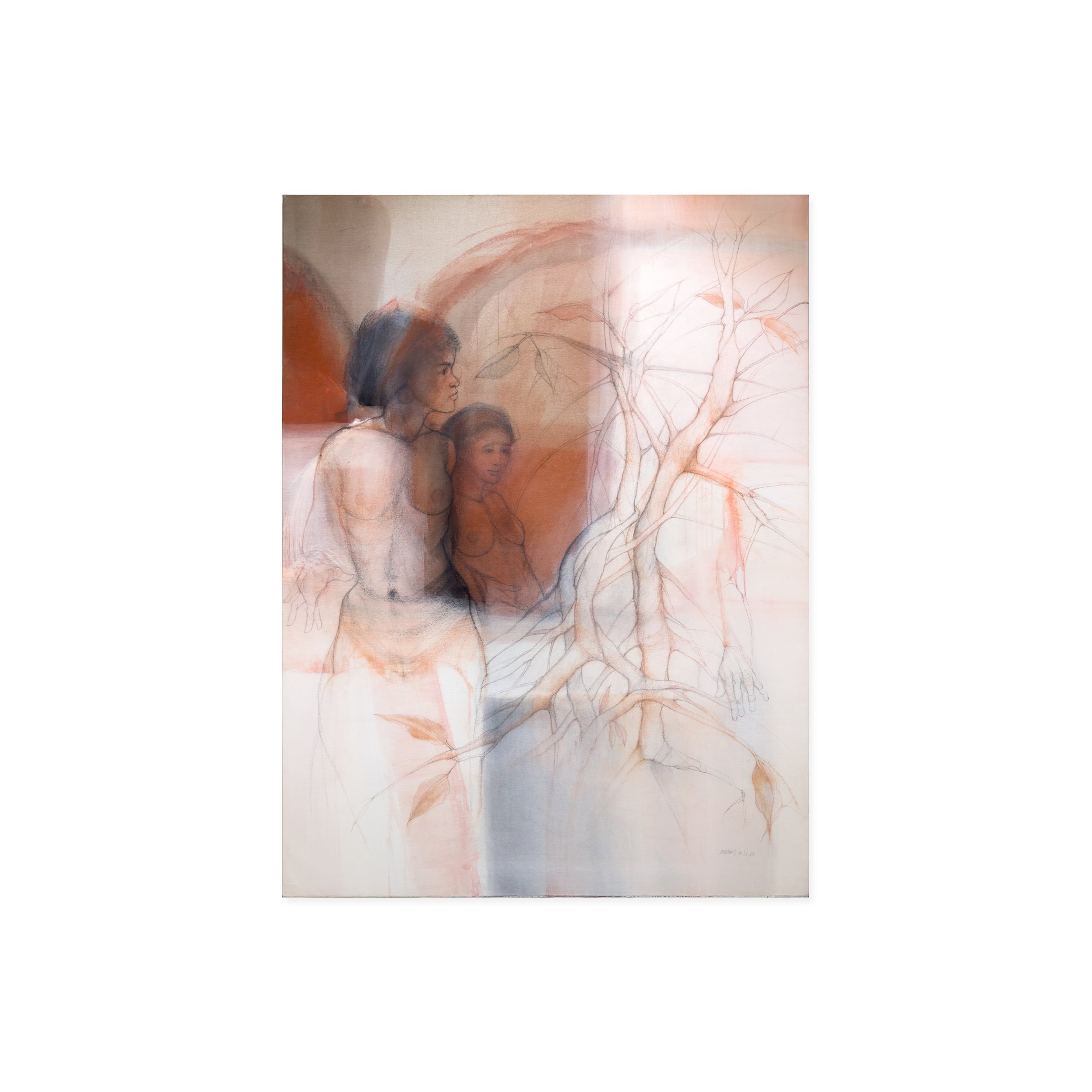
Conquistando Libertades I (2023) is an original painting by Colombian artist Rafael Dussan, made with acrylic and charcoal on canvas, measuring 150 × 200 cm, available through Matiz Gallery in Barcelona. Drawing and the human body are central to Dussan’s practice. Here, two nude Afro-descendant women occupy the left side of the composition, while a mangrove extends across the right. Fine lines, translucent layers and warm earth tones give the scene a quiet, mysterious atmosphere.
The mangrove places the work within a recognisable Caribbean landscape. These coastal forests support fishing and provide resources that sustain surrounding communities. Knowledge of their waters, seasonal changes and species forms part of the practical understanding through which people inhabit and care for the territory. In Colombia’s Caribbean region, community management of mangroves continues to bring together livelihoods and conservation.
This relationship between people and water has a long regional history. In the floodplains of the Colombian Caribbean, Indigenous Zenú societies developed extensive networks of canals and camellones—raised agricultural beds. These systems directed floodwaters, retained moisture during dry periods and used river sediment to nourish crops. Built through generations of accumulated knowledge, they demonstrate sophisticated engineering and agricultural organisation. Although these floodplains are distinct from coastal mangroves, they belong to a wider history of learning to live with water and shape the territory through its cycles.
Territory also mattered in struggles against colonial slavery. Across the Colombian Caribbean, people escaping enslavement established palenques: communities that defended their freedom through settlement, food cultivation and networks of exchange. Maintaining autonomy involved knowing where to live, how to obtain food and how to organise relationships with neighbouring populations. Freedom depended on the material conditions that made an independent life possible.
These histories accompany the painting within Cuerpo y territorio (Body and Territory), the third exhibition in BASPcr, Matiz Gallery’s programme connecting art, intercultural exchange and research into the neighbourhood where the gallery operates. The exhibition asks visitors to consider the body as a means of expression and territory as the place, resources and structures of power that shape everyday life.
In Barcelona’s Sant Pere, Santa Caterina i la Ribera neighbourhood, the programme pays attention to how immigrant communities bring cultural practices, gestures and knowledge into the city. The body expresses this presence through movement, dance, dress and everyday encounters. Learning about territory means understanding the neighbourhood’s history, how it is governed and who makes decisions about the spaces and resources we share.
Within this exhibition, Conquistando Libertades I introduces a conversation about bodily freedom and the conditions needed to sustain it. The Caribbean histories surrounding the work bring knowledge, subsistence and collective organisation into that conversation. BASPcr carries these questions into the place where we live and work, using cultural exchange and territorial research to strengthen our capacity to act, resist and change our material circumstances.
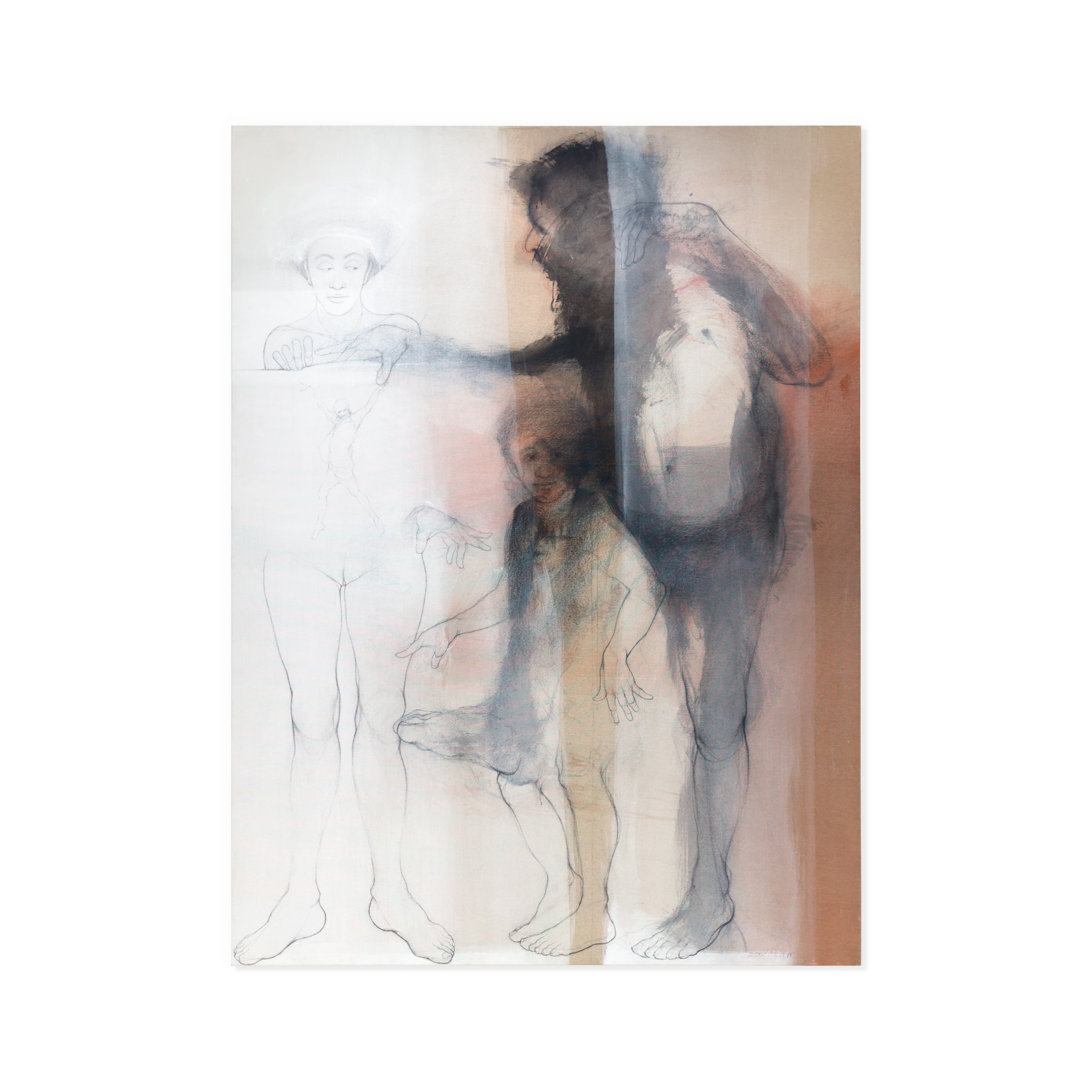
Conquistando Libertades II is an original painting by Colombian artist Rafael Dussan, measuring 150 × 200 cm, available through Matiz Gallery in Barcelona. A woman stands on the left, a man on the right and a child between them. Delicate outlines contrast with darker passages of colour, while carefully articulated hands and overlapping gestures give the scene its expressive complexity.
Dussan’s command of figurative drawing is evident in the fine contours of the bodies, faces and fingers. Some forms are barely traced against the pale background; others acquire weight through dense shading and earth tones. A small dancing figure appears within the composition, adding another scale of bodily expression. The attention given to hands makes gesture an essential part of the scene’s poetic language.
Originally conceived within a triptych that also included Conquistando Libertades I, the painting forms part of a larger visual narrative. Seen alongside the women and mangrove of that companion work, its figures enter a shared context of Caribbean histories, bodily freedom and territory. The relationship between the scenes develops through recurring bodies, gestures and symbols, allowing meaning to accumulate across the works.
The encounter remains unresolved. The positioning of the adults and child, the direction of their attention and the movement suggested by their hands leave space for different understandings of their relationship. This openness belongs to the painting’s poetry: a scene can hold intimacy, uncertainty and tension without settling into a single account. Within the exhibition’s context of Latin American magical realism, the small dancing body and shifting scale bring the familiar human encounter into an enigmatic register.
The work is presented in Cuerpo y territorio (Body and Territory), the third exhibition in BASPcr, Matiz Gallery’s programme connecting art, intercultural exchange and research into its surrounding neighbourhood. The exhibition brings attention to two concepts: the body as a means of expression, and territory as the material and political conditions in which life unfolds.
Here, gesture offers a direct entry into the exhibition. Hands, posture and movement communicate before a story is fully understood. In Barcelona’s Sant Pere, Santa Caterina i la Ribera neighbourhood, BASPcr considers how immigrant communities carry and transform forms of expression through dance, cultural practices and everyday presence. These expressions contribute to how the neighbourhood is inhabited and experienced.
The wider narrative of Conquistando Libertades also opens questions about the conditions in which freedom becomes possible. BASPcr approaches territory through learning about where we live and work: its history, resources, governance and the people and institutions shaping it. Placing these questions alongside Dussan’s scenes connects the expressive freedom of the body with the collective knowledge needed to organise, resist and act upon our surroundings.
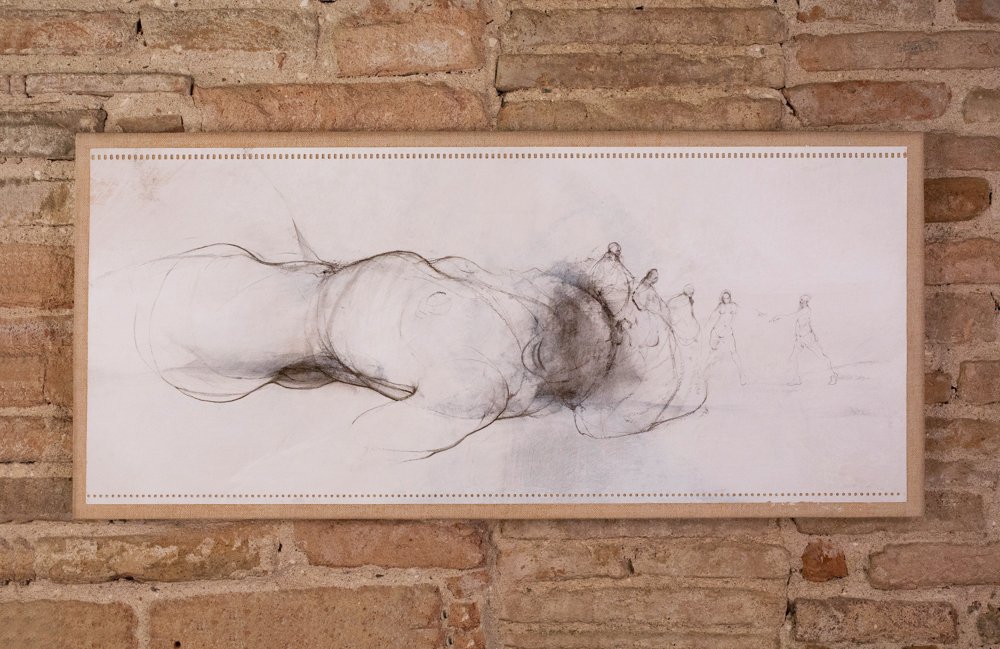
35 x 81 cm
Mixed Media acrylic, charcoal, pigments, and pastel on laid paper. (Prices excl. VAT)
Painting from Rafael Dussan
One-of-a-Kind Artwork with an Authenticity Certificate
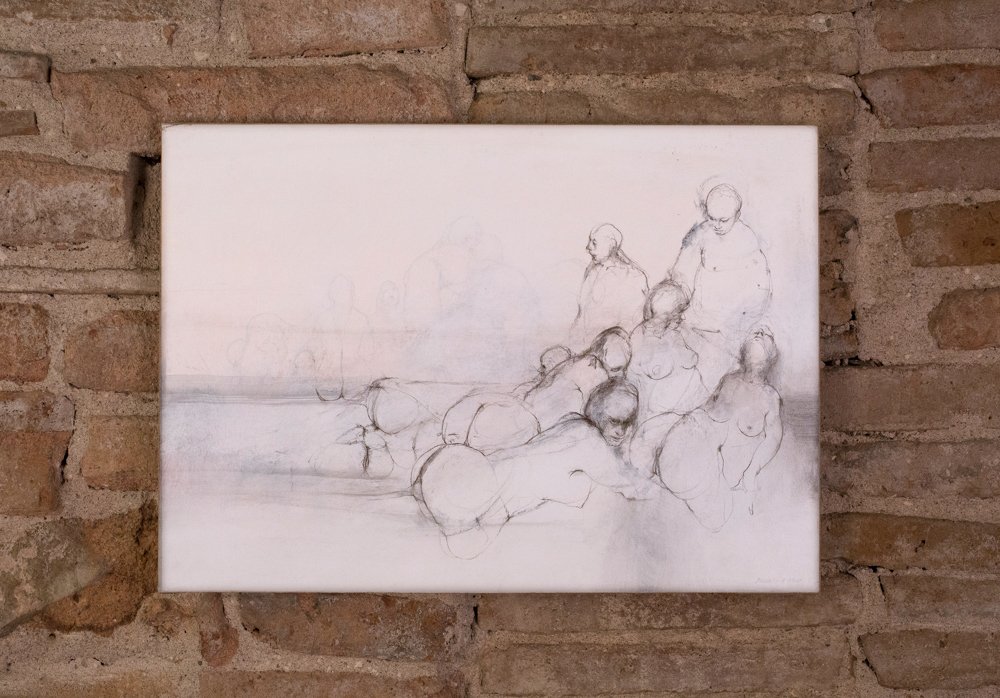
33.5 x 48 cm
Mixed Media acrylic, charcoal, pigments, and pastel on laid paper. (Prices excl. VAT)
Painting from Rafael Dussan 2009
One-of-a-Kind Artwork with an Authenticity Certificate
Discover "Humanidades" (2009), a mixed media masterpiece by Rafael Dussan. Created with acrylic, charcoal, pigments, and pastel on laid paper, this artwork embodies Dussan’s exploration of human nature and emotion. A compelling piece showcasing his Renaissance-inspired style and technical mastery, "Humanidades" is a must-see at Matiz Gallery.
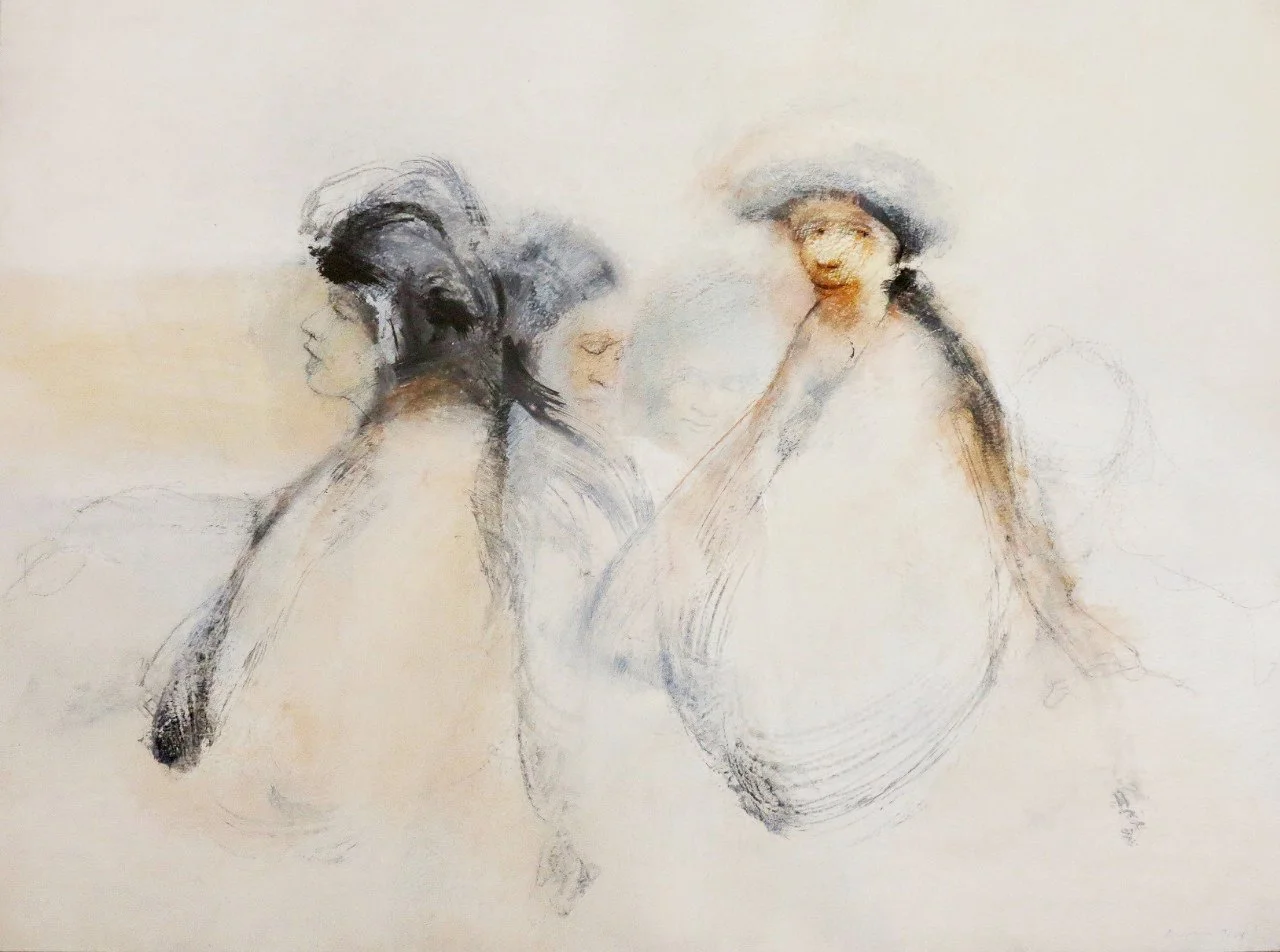
64 x 49 cm
Mixed Media acrylic, charcoal, pigments, and pastel on laid paper. (Prices excl. VAT)
Painting from Rafael Dussan 2018
One-of-a-Kind Artwork with an Authenticity Certificate
Explore "Onírico 2" (2018) by Rafael Dussan, a 49 x 64 cm mixed media artwork crafted with acrylic, charcoal, pigments, and pastel on laid paper. This evocative piece captures dreamlike states and human emotion, showcasing Dussan’s exceptional technique and artistic depth. Discover this masterpiece now at Matiz Gallery.
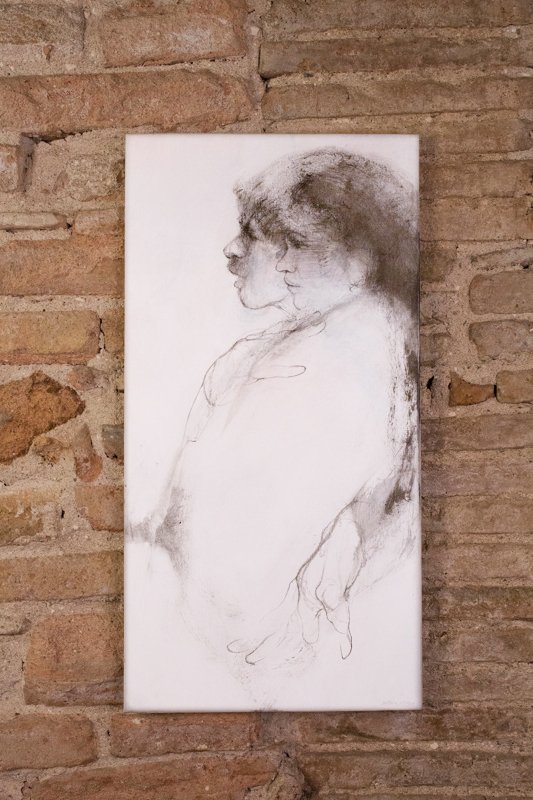
60 x 30 cm
Mixed Media acrylic, charcoal, pigments, and pastel on laid paper. (Prices excl. VAT)
Painting from Rafael Dussan 2009
One-of-a-Kind Artwork with an Authenticity Certificate
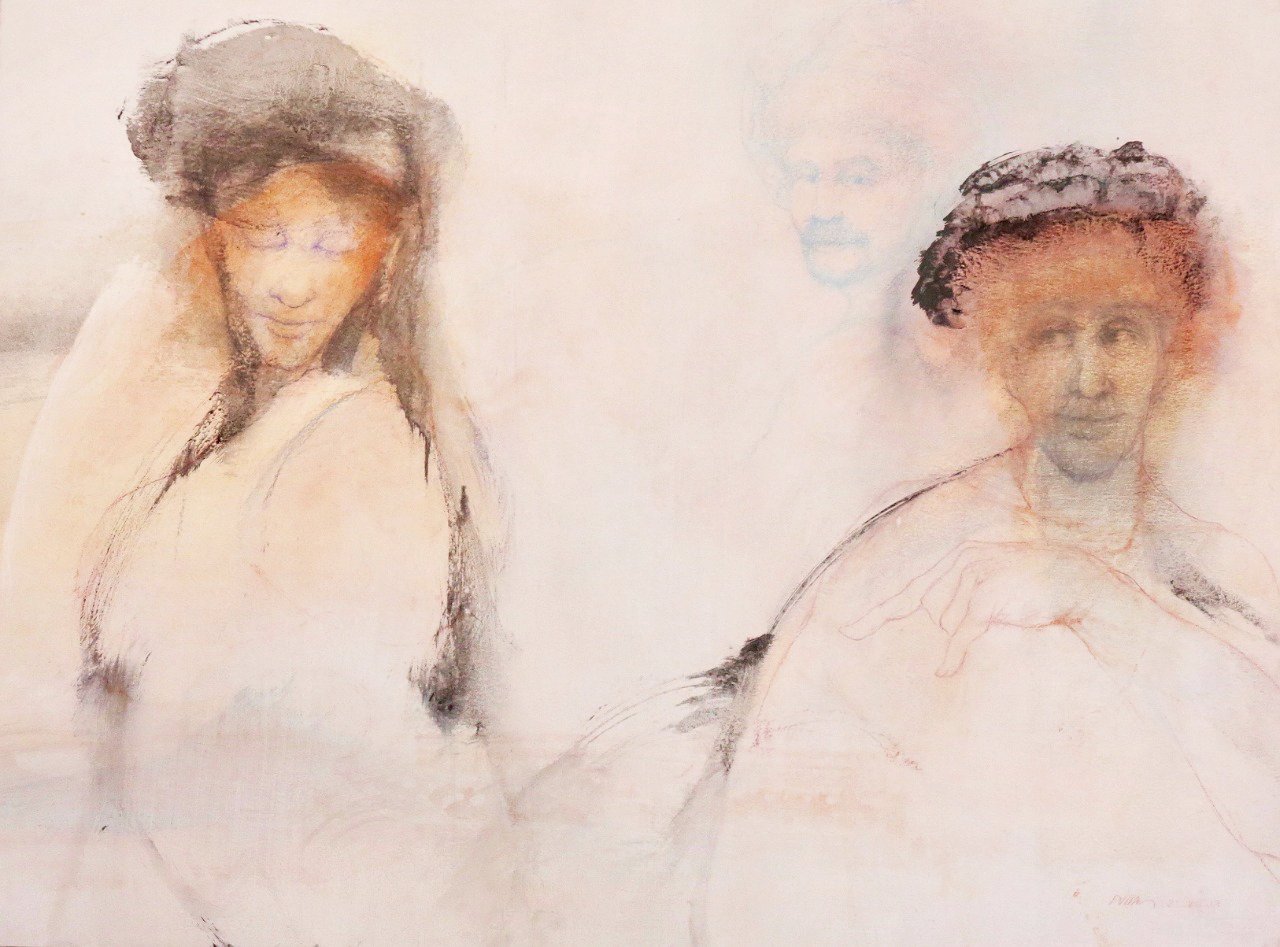
49 x 64 cm
Mixed Media acrylic, charcoal, pigments, and pastel on laid paper. (Prices excl. VAT)
Painting from Rafael Dussan 2018
One-of-a-Kind Artwork with an Authenticity Certificate
Discover "Onírico 1" (2018) by Rafael Dussan, a 49 x 64 cm mixed media piece blending acrylic, charcoal, pigments, and pastel on laid paper. This captivating artwork reflects Dussan’s exploration of dreamlike states and human introspection, showcasing his masterful technique and emotional depth. View it now at Matiz Gallery.
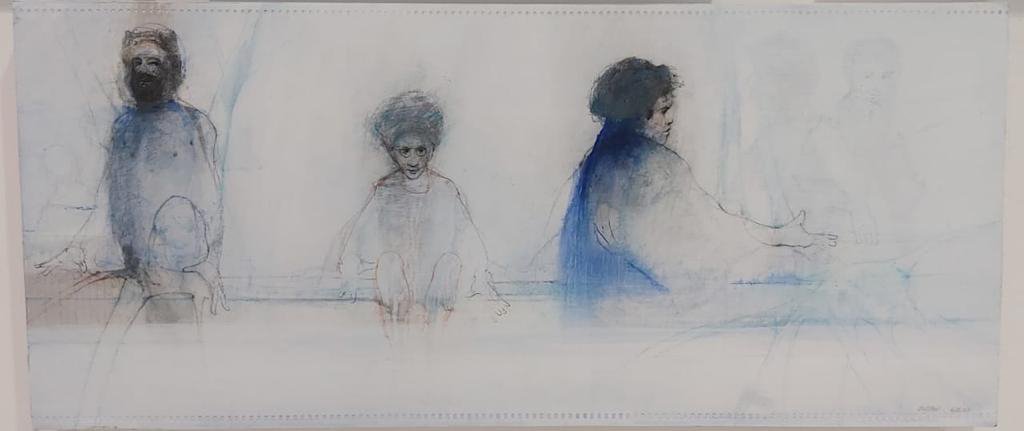
35 × 80 cm
Mixed Media acrylic, charcoal, pigments, and pastel on laid paper. (Prices excl. VAT)
Painting from Rafael Dussan 2018
One-of-a-Kind Artwork with an Authenticity Certificate
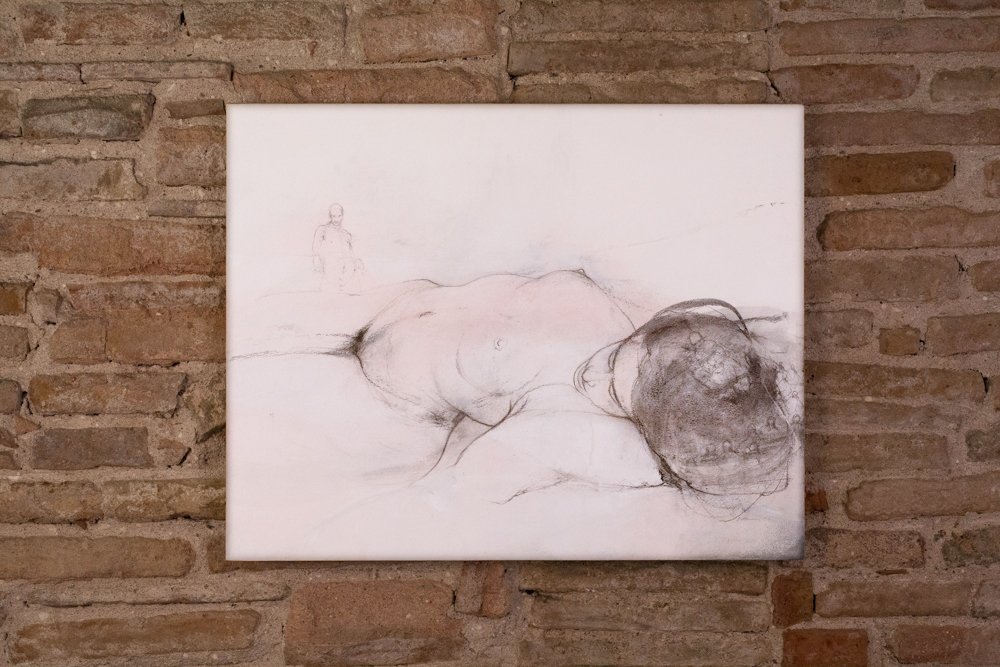
50 x 64 cm
Mixed Media acrylic, charcoal, pigments, and pastel on laid paper. (Prices excl. VAT)
Painting from Rafael Dussan 2009
One-of-a-Kind Artwork with an Authenticity Certificate
Discover "Humanidades" (2009), a mixed media masterpiece by Rafael Dussan. Created with acrylic, charcoal, pigments, and pastel on laid paper, this artwork embodies Dussan’s exploration of human nature and emotion. A compelling piece showcasing his Renaissance-inspired style and technical mastery, "Humanidades" is a must-see at Matiz Gallery.